
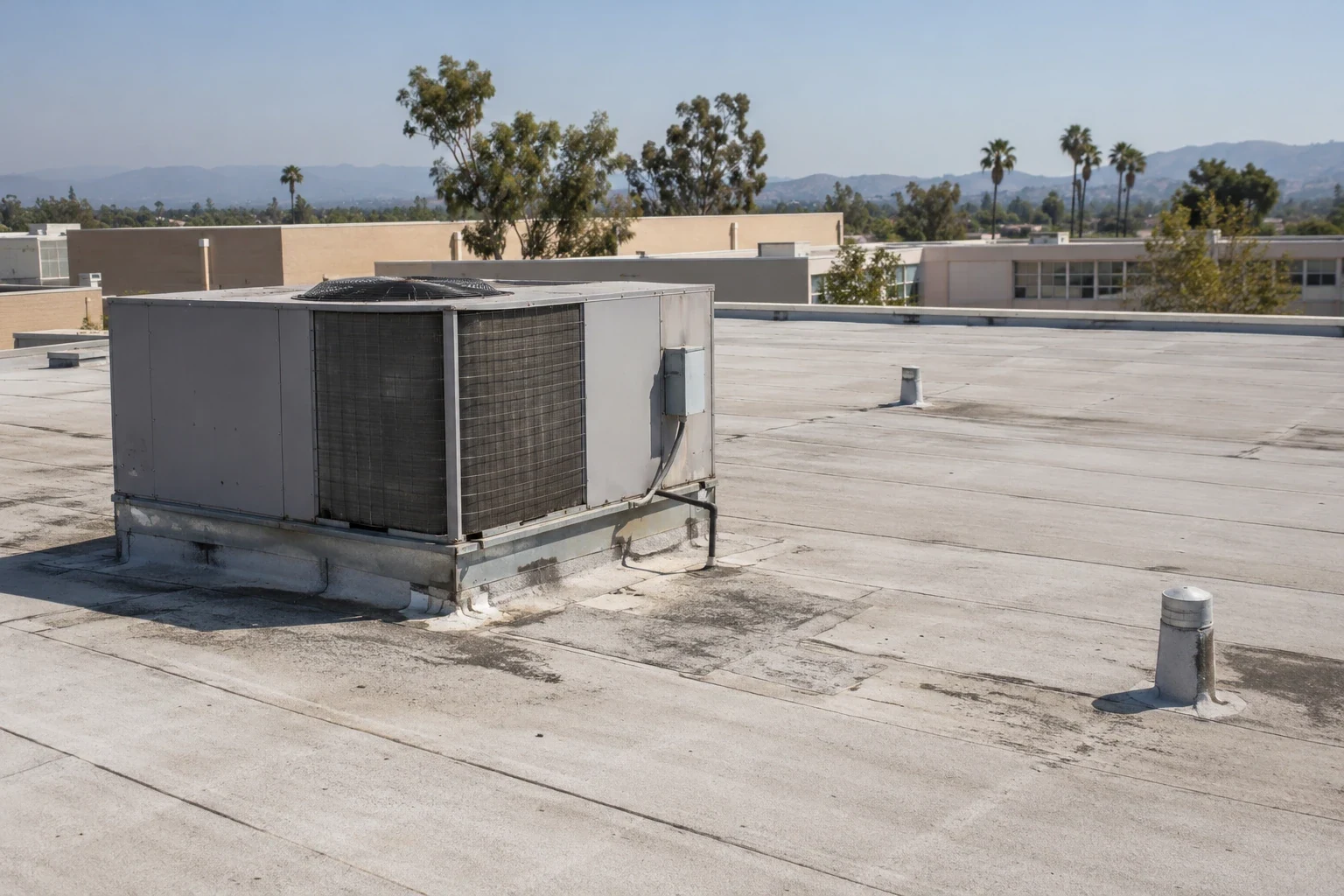
Commercial Roofing in Visalia’s Court and Paradise District
Service Areas | Visalia and Tulare County
Court and Paradise District
A leak over a clinic suite or professional office needs a contained inspection plan. In its current plan, Visalia groups the Court and Paradise area among several medical uses in a tract that also carries office, neighborhood-commercial, mixed-use, and light-industrial designations. That makes the district a useful geographic description, not a statement about any one roof. We confirm the property, access, and assembly on site before defining the work.
Separate the roof leak from the ceiling mark
A stain below a medical or office suite can spread along a deck flute or through insulation before it appears indoors. We note the room, timing, and weather, then compare the mark with roof seams, equipment curbs, drains, and wall transitions. The first pass should identify a likely path and a test boundary. We do not enlarge the opening until the visible evidence supports it.
The district's mix of office, retail, and service uses does not prove what sits in an individual building. We ask the manager about occupied areas, sensitive rooms, and access limits before a commercial roof inspection. The report records the roof section, observed condition, and any uncertainty that still needs a core or other test.
Organize the roof walk by section
A roof plan may combine original construction with additions, equipment changes, or repairs. We check those areas separately and note membrane type where it can be identified, attachment, seams, penetrations, and edge transitions. Softness, blistering, or a prior patch is a reason to investigate, not automatic proof of widespread moisture. The manager receives a list of sections examined and any area that could not be reached.
We plan the inspection route with the property contact so roof access does not disrupt an appointment schedule or block an exit. If equipment must stay online, the responsible person identifies what may be approached and what requires an escort. The district covers multiple properties, but field conditions and owner rules govern the actual walk.
Trace drains and low areas
At each drain, we inspect the bowl, strainer, sump, overflow, and roof surface feeding the outlet. A clear drain can sit in a low area that still holds water against a seam. We look for compressed insulation, ponding, open laps, and evidence of overflow, then distinguish a maintenance issue from a change in slope or a concealed assembly problem.
Water leaving the building also matters. We note where scuppers and downspouts discharge and whether runoff could reach a public path or service entrance. Drain cleaning, membrane repair, and drainage reconstruction are separate scope items. If seasonal checks are useful, a roof maintenance program can document outlets and details without suggesting that routine maintenance repairs a failed deck.
Inspect around curbs and walls
Pipe boots, curb corners, parapet caps, skylight edges, and wall flashings can open as materials move. We inspect laps and terminations for separation, brittleness, loose metal, or sealant that no longer bridges the joint. When an edge repair ties into a wall, the scope needs to show how the new flashing terminates. “Reseal perimeter” is too broad to price or verify.
Visalia's Visalia's climate averages provide regional heat context, not a product failure diagnosis. We check actual surface and weather conditions before selecting a repair material. An EPDM roofing assembly is considered only after we confirm substrate, insulation, attachment, and detailing compatibility. The name of a system does not establish that it can be placed over an existing roof.
Set limits for leak repair
A contained opening can support a local repair when adjacent membrane and insulation remain serviceable. We mark the area removed, identify the tie-in surface, and state how wet material will be handled. If testing shows moisture beyond the first cut, we pause and show the manager the evidence before extending the boundary. That makes a change order explainable rather than surprising.
When the roof plan shows several layers or a history of repairs, we note which areas have been disturbed and where original material remains visible. A core or test cut should answer a defined question, such as moisture extent or assembly depth. We photograph the opening and close it with the specified repair. The owner can then compare the test result with the replacement or recovery assumptions in the estimate.
When the entry point is a failed lap or flashing, commercial roof leak repair can be scoped to that detail and the surrounding sound material. Repeated failure across multiple sections may justify comparing repair with commercial roof replacement. Each option should state tear-off limits, insulation assumptions, deck allowances, interior protection, and close-in steps so the owner can compare scope rather than headline price.
Protect occupied suites
Work above an occupied clinic or office calls for a contact who can coordinate access and communicate changes. We agree on roof entry, lift placement, noise periods, dust control, and what interior area needs protection before opening the assembly. The crew works in sections that can be secured at the end of the shift. If weather interrupts the plan, the scope states the temporary tie-in and who verifies it.
Before an opening is made, we confirm where occupants can be relocated or protected, how dust and noise are managed, and who can authorize a shutdown. Those controls are specific to the building and the work area. If the roof sits above several suites, the sequence can keep one section closed while another remains available. The daily close-in check verifies that temporary tie-ins and interior protection are still in place.
A photo log helps the manager connect roof activity with tenant reports. We label each photo to a roof area, note when the condition was observed, and keep the repair boundary visible. A roof condition report can carry the original finding through completion, including any concealed condition that changed the work.
Keep findings tied to the property
The closeout separates completed work from remaining conditions. We list sections opened, material installed, flashing changes, and any area deferred for access or testing. Photos should identify direction and roof zone. If water reappears, the manager can compare the new path with the prior repair instead of assuming that the original opening failed again.
For properties spread across Visalia, the Visalia Industrial Park and Business Research Park illustrate different planning contexts, not a shared roof history. A consistent roof asset management keeps each asset's plans, warranty documents, inspection notes, and repairs attached to the right building. Share the suite location, roof access rules, and prior work record so the next visit can answer a specific question.
Commercial Roofing Questions
What makes a roof inspection appropriate over a medical office?
We coordinate access and any restrictions before the walk, then inspect the roof section above and around the reported issue. The written findings distinguish visible damage from concealed conditions that require testing.
Can a repair stay limited to one tenant area?
It can when testing shows the assembly is dry and serviceable beyond the leak path. We mark what is included and explain any nearby condition that remains outside the repair.
How do you handle a roof opening above active appointments?
The site contact chooses an approved window and confirms interior protection below. We keep the exposed area small, close it watertight each shift, and identify a contact for schedule changes.
What should a manager compare in coating proposals?
Check substrate preparation, moisture assumptions, detail repairs, product compatibility, application limits, and warranty terms. A coating should not cover wet insulation or leave a drainage defect unresolved.
Will a leak report identify what still needs attention?
Yes. A useful report marks the repaired roof area, photos, materials, and any additional test or work that was not authorized. It should not treat an uninspected section as sound.