Commercial Roofing in Northwest Visalia, Visalia, CA
Service Areas | Visalia and Tulare County
Northwest Visalia
A roof near a developing employment area needs a clear distinction between current conditions and future land-use plans. Northwest Visalia growth follows an urban development boundary and phased tiers; every edge parcel is not necessarily built or operating. We use that context to plan access and logistics, then inspect the actual roof assembly, drainage, and penetrations. The first walk records the condition that exists today and the tests needed before repair or capital work is priced.
Separate Current Use from Planned Growth
Planning language can describe industrial, research, light-industrial, and airport-industrial categories without confirming the use of a specific property. We do not infer a roof type, occupancy, or operating schedule from a map designation. The manager identifies the building and its current use; we confirm roof access, active equipment, safety rules, and any work happening below. If the property is still under construction or a tenant fit-out is underway, those facts shape the work window and protection plan.
The City’s phased-growth approach also makes location context important when coordinating deliveries. We confirm the actual entrance and staging area rather than assuming future roads or utilities are in place. Once on the roof, we identify membrane type, deck transitions, curbs, perimeter details, and drainage. A condition inspection can separate observed defects from untested sections and give the owner a usable baseline.
Map Penetrations Before They Leak
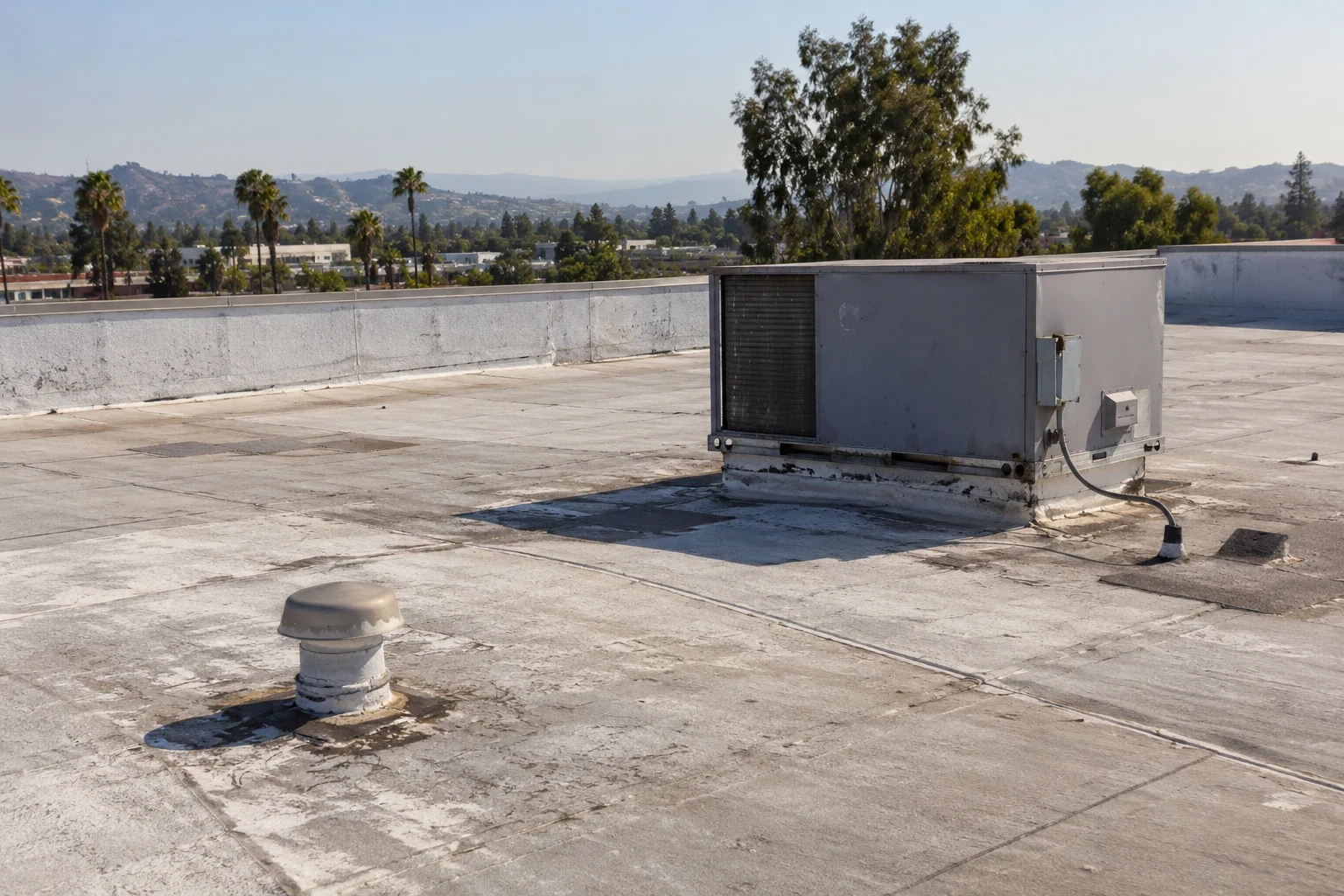
Mechanical curbs, conduit supports, exhausts, and later tenant equipment interrupt the roof field. We check each flashing where it meets the membrane and look for fastener movement, open corners, cracked sealant, and water staining below. An equipment replacement can leave a curb larger or smaller than the previous one, which changes the detail. We identify the contractor coordination needed before a new unit is set so roofing work can restore the membrane rather than patch around an unfinished curb.
For larger or difficult-to-access roof areas, drone images can help document layout and identify areas for closer review. They do not replace hands-on checks at seams and penetrations. If moisture signs are unclear, an infrared moisture survey or test cut may help locate wet insulation. We label the tested area and avoid presenting a scan as proof about places outside its coverage.
Give Rain a Continuous Route
Visalia’s dry season can leave outlets and roof edges unchecked until rain returns. We inspect drain bowls, scuppers, downspout connections, and the membrane around each opening. A blocked outlet and a low roof section may look similar from above, but they require different corrections. We check the outlet and trace runoff to its discharge point, then record any ponding that remains after nearby areas drain.
Northwest planning categories include commercial corridors such as Highway 198, Mooney Boulevard, and Goshen Avenue. Those are broader city connections, not evidence of a condition on a given roof. We use the building’s own slope and drainage layout to define work. If the roof is low-slope and a seam feeds water toward a wall, a localized flashing repair may be enough. If water holds across a broad section, we evaluate insulation and slope before an overlay is considered.
Inspect Details Through the Hot Season
Visalia’s hot season can stress exposed membrane and sealant, especially where details move against metal or masonry. The Visalia normal for the local station includes repeated days above 90 degrees Fahrenheit. We look for brittle sealant, lifted laps, dried patches, and movement at curb corners, but temperature history alone does not prove damage. The roof walk ties every recommendation to a visible defect, moisture check, or tested joint.
Where a repair is isolated, we keep the scope contained and document the materials used. If several seams have opened or patches overlap, we test whether the issue is limited to workmanship at a few details or reflects broader system wear. A coating, recover, and replacement each have prerequisites. We compare them after checking moisture, attachment, existing layers, and drainage. The Visalia Industrial Park and Business Research Park are distinct planned service areas, not substitutes for this building’s inspection. The commercial roof repair scope and commercial roof replacement evaluation should both state what remains outside the tested boundary. The report can also mark roof sections that were blocked by equipment, locked access, or active work so no reader mistakes an uninspected area for a sound one. If access improves later, we can complete that portion and update the record. For a manager comparing several sites, keeping the same location labels and photo directions makes change easier to spot, but each roof still receives its own finding and repair recommendation.
Sequence Work with Site Operations
Industrial, research, and service uses may require deliveries, equipment access, and tenant coordination. We ask when roof hatches, docks, or parking areas are available and whether any process must stay undisturbed. Work above occupied rooms needs interior protection and a close-in plan. For larger replacement scopes, we sequence tear-off, insulation, membrane, and temporary dry-in by section rather than leaving open areas exposed beyond the agreed work window.
If cranes, HVAC technicians, electrical crews, or other trades need roof access, we coordinate around the same penetrations and equipment curbs. That avoids separate trades leaving the membrane open or a flashing incomplete. The metal retrofit option may be relevant for some existing assemblies, but we verify structural support and attachment before recommending it. Site-specific access notes belong in the schedule and the written work plan.
Make the Roof Baseline Transferable
A roof record should let the next manager understand what was checked without having to reconstruct the visit. We label the areas, include photos of defects and sound transitions, note moisture findings, and list any section that was inaccessible. If a repair is made, we show its boundary and the detail restored. The record also notes the building use and the work window that governed access, because those constraints may change with a tenant or process schedule. We confirm construction status at the parcel before planning access or material delivery.
Visalia’s planning documents distinguish employment categories and phased growth; a roof file should distinguish confirmed building conditions from assumptions in a plan. Share the site location, roof plans, leak notes, and access rules before the first walk. We will confirm which areas can be inspected, record what the evidence supports, and return a scoped recommendation. That gives an owner a sound starting point for maintenance, budgeting, or a future replacement decision.
Commercial Roofing Questions
Do planned land uses tell you whether a building is active?
No. We confirm current occupancy, roof access, equipment, and construction status with the property contact. A planning category is context, not a site inspection.
Can a drone inspection find every leak?
No. Aerial images help map the roof and select areas for close review. We still inspect seams and penetrations directly, then use moisture testing when visual evidence leaves a question.
What should happen before new rooftop equipment is installed?
We coordinate curb dimensions, flashing responsibility, access, and close-in timing with the mechanical trade. The membrane should be restored around the final curb, not left to an improvised patch.
How do you evaluate a roof with several old patches?
We inspect patch edges, adjoining seams, and moisture indicators. The findings show whether contained repair remains practical or whether broader system work needs comparison.
What belongs in a baseline roof report?
Photos, roof-area labels, observed defects, moisture results, repair boundaries, access limits, and follow-up tests provide a useful record for the next manager and budget review.